


 By neha - June 24, 2026
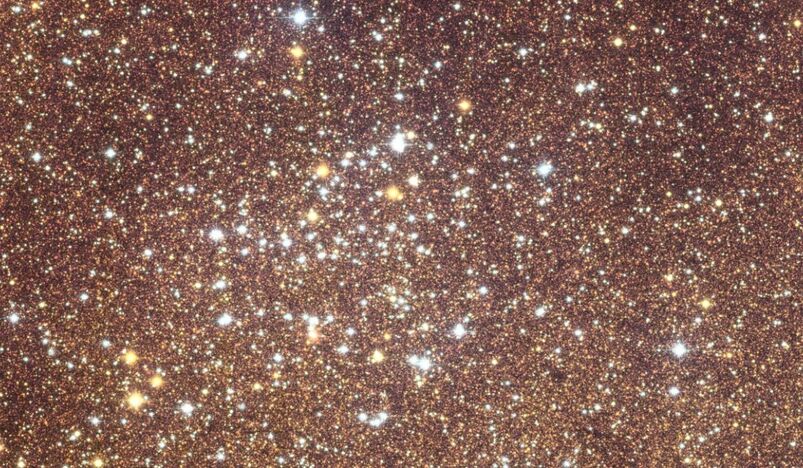
The European Space Agency's Euclid space telescope has just delivered a record-breaking achievement. On Wednesday, the ESA released the largest and most detailed image ever taken of the Milky Way's crowded galactic centre. The photograph packs more than 60 million stars into a single breathtaking mosaic — and it could change how scientists hunt for planets beyond our Solar System.
What Makes This Image So Extraordinary
This is not just a pretty picture. Scientists spent 26 hours in March 2025 pointing Euclid's visible-light camera at nine separate sections of the galactic bulge. Each section covered a patch of sky larger than the full Moon. Together, they produced one seamless mosaic of our galaxy's bright, star-crammed heart.
The galactic bulge sits at the centre of our spiral galaxy. French astronomer Jean-Charles Cuillandre, who works directly on the Euclid mission, described it as "a large bubble containing billions of stars." Seen from roughly 26,000 light-years away, the view reveals not just stars but also dark patches of dense molecular clouds. Those clouds absorb and scatter light from behind them, creating eerie dark voids in an otherwise blazing scene.
The original image arrived in black and white. Colour was later added using observations from the Canada-France-Hawaii Telescope in Hawaii, giving the final image its vivid golden and reddish hues.
A Telescope Built for a Different Job — But It Works
Euclid launched in July 2023 aboard a SpaceX Falcon 9 rocket from Cape Canaveral. Its primary mission targets the mysteries of dark matter and dark energy. It sits 1.5 million kilometres from Earth and was designed to observe billions of distant galaxies across one-third of the sky.
Turning it toward the Milky Way was not part of the original plan. The galactic centre is one of the brightest, most crowded regions in the entire sky — the opposite of what Euclid was built to study. Yet Cuillandre said the result surprised even the scientists involved.
"Now we've decided to point Euclid at the brightest area of the sky — and it works superbly, it's extraordinary," he told reporters.
The reason it works is Euclid's exceptional optical precision. Its visible-light camera separates individual stars in an environment so packed with light that most instruments would struggle. That sharpness is what makes this image scientifically useful, not just visually striking.
How This Helps Scientists Find Planets Around Other Stars
The image carries immediate value for exoplanet research. Astronomers use a method called microlensing to find and measure planets orbiting distant stars. It works like this: when a closer star moves in front of a more distant one, the nearer star bends and amplifies the background star's light. Scientists call it a "cosmic magnifying glass."
If a planet orbits the closer star, its gravity causes a tiny additional shift in brightness. That small change reveals the planet's existence and lets scientists calculate its mass.
French astronomer Jean-Philippe Beaulieu of the Institut d'Astrophysique de Paris has spent two decades working with this technique. He noted that nearly 300 exoplanets have already been discovered through microlensing — all found using ground-based telescopes, and all pointing toward the galactic centre. His own team discovered an icy, distant world using this method twenty years ago. He playfully compared it to Hoth from Star Wars.
Euclid's new image already contains 51 known planetary systems. Beaulieu confirmed the image will also support future exoplanet discoveries. Any future telescope that detects a microlensing event in the same region can now use Euclid's 2025 data as a precise baseline for comparison.
A Time Reference for Future Missions Including NASA's Roman Telescope
Natalia Rektsini of the Institut d'Astrophysique de Paris leads the release of Euclid's galactic centre survey data. She explained why the timing of this observation matters beyond the image itself.
"With time, the separation between sources and lenses increases," she said. "That's why this Euclid data will be a time reference for past and future missions and enable studies of exoplanets and their masses."
The Euclid mosaic covers the exact region that NASA's upcoming Nancy Grace Roman Space Telescope plans to monitor for microlensing events. Roman is expected to launch aboard a SpaceX Falcon Heavy rocket as early as August 2026. Once it begins operations, researchers can compare Roman's live detections against Euclid's March 2025 baseline — like checking a before-and-after photograph to spot what changed.
The data from this release also opens up research into brown dwarfs, binary star systems, stellar motion, and dust distribution across the galaxy.
What the Dark Patches in the Image Actually Mean
One detail in the image confuses many first-time viewers. Large areas appear completely black — seemingly empty of stars. They are not empty at all.
Those dark patches are dense molecular clouds filled with dust and gas. They sit between Earth and the galactic bulge, blocking visible light from the stars behind them. Astronomers study these clouds because they are often stellar nurseries — regions where new stars form under intense gravitational pressure.
The contrast between the glowing star-packed bulge and these inky foreground clouds gives the image its dramatic character.
Euclid's Broader Mission Continues
The galactic centre image is a bonus achievement alongside Euclid's core purpose. The telescope is on a six-year mission to map more than one-third of the extragalactic sky. Its primary goal remains producing the largest three-dimensional map of the universe ever created — tracking billions of galaxies up to 10 billion light-years away.
That data will help scientists understand how dark energy drives the accelerating expansion of the universe. The mission's first major cosmology data release is expected in October 2026.
More than 2,000 scientists from 300 institutions across 15 European countries, the United States, Canada, and Japan contribute to the Euclid Consortium. NASA provided key detectors for the telescope's near-infrared instrument.
Key Facts at a Glance
- Stars visible in the image: over 60 million
- Observation date: March 23, 2025
- Observation time: 26 hours
- Number of image panels: nine
- Distance from Earth to galactic centre: approximately 26,000 light-years
- Euclid's distance from Earth: 1.5 million kilometres
- Known planetary systems visible in the image: 51
- Euclid launch date: July 1, 2023
Why This Matters
Space telescopes have shown us distant galaxies, dying stars, and the edges of the observable universe. This image turns the lens inward — toward our own home galaxy's dense, chaotic heart. It proves that a telescope designed for the deep dark universe also sees extraordinary detail right here in our own cosmic neighbourhood.
For astronomers, exoplanet hunters, and anyone who has ever looked up on a clear night and wondered what lies at the centre of the Milky Way, Euclid has just delivered the clearest answer yet.

_20-08-2026_05-08.jpg)
_27-51-2026_11-51.png)
_27-43-2026_12-43.png)



.jpg)
.jpg)




.jpg)


.jpg)
.png)
.jpg)













Leave a comment